
Alexander County Court Arrest Path
After an Alexander County jail arrest, two records tracks run at the same time. The sheriff's system records booking, custody status, bond fields, and the jail roster entry. The court system records the criminal case. The North Carolina Judicial Branch Alexander County page places the county in Prosecutorial District 32, Superior Court District 32, and District Court District 32. It also links court dates, calendars, courthouse information, payments, and the local contact directory.
The pathway is arrest, booking, first appearance, release-condition decision, filed charges, court dates, and final disposition. A judge or magistrate sets conditions of release after the person is brought before a judicial official. The District Attorney's Office decides how to prosecute. The prosecutor-filed charge can differ from the initial jail booking allegation, so a P2C charge should not be treated as the final court outcome.
The Alexander County court screenshot in the image set is from the Judicial Branch county page.
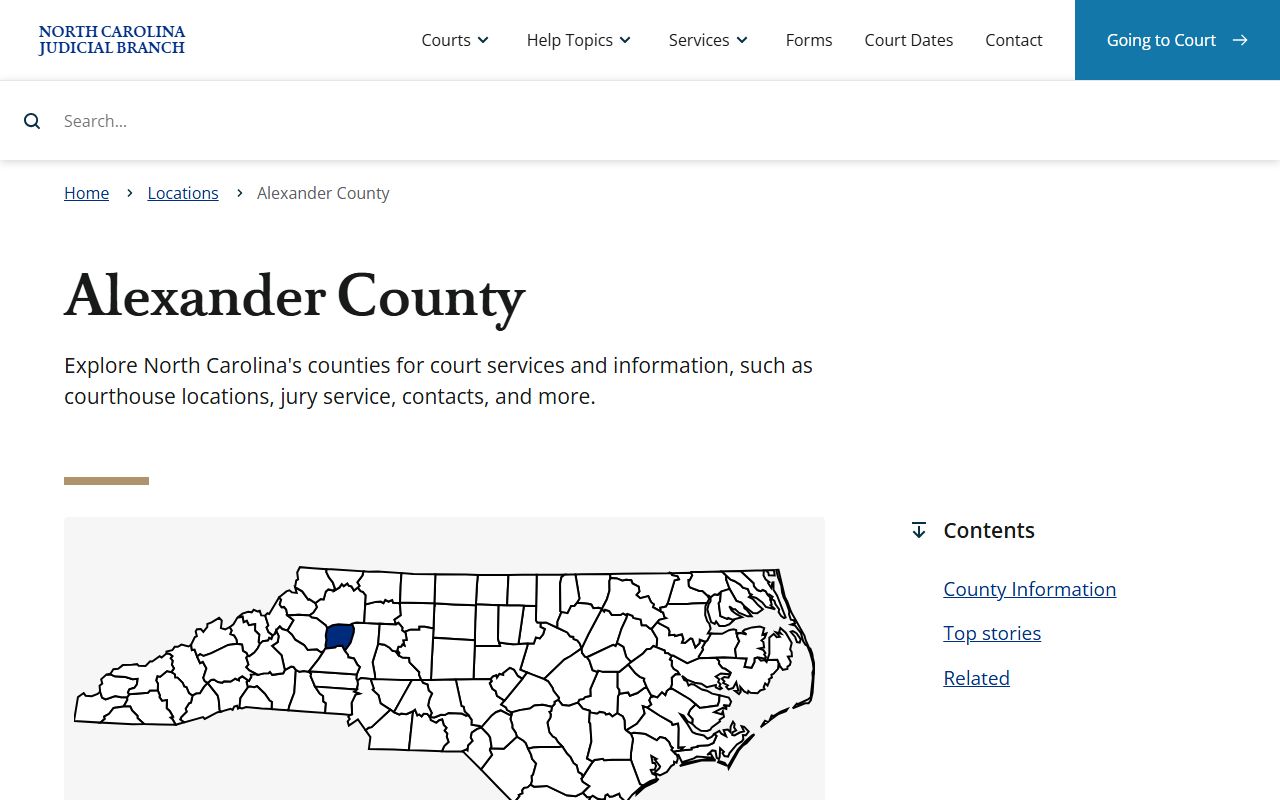
The court page is the better source for calendars, court dates, courthouse contacts, and case-access routing after the jail booking step.
Search Alexander County Court Records
The Judicial Branch court-records guidance says criminal case information can be accessed at public, self-service terminals in clerk of court offices. The terminal can be searched by defendant name, case number, or victim/witness name. Paper court files are accessed through the clerk's office in the county where the case is located, and copies may be made for a fee.
Alexander County court dates can also be searched through the Judicial Branch using name, citation number, county, and related filters. That court-date search helps when the jail roster shows a court date but the reader needs the court location, calendar, or next hearing status. For custody and booking fields, use the Alexander County jail inmate records page; for the court case, use Judicial Branch tools and the clerk.
| Search field | Where used | Notes |
|---|---|---|
| Defendant name | Clerk public terminal | Primary way to find a criminal case when the case number is unknown |
| Case number | Clerk public terminal | Best when listed on a charge, citation, or court notice |
| Victim or witness name | Clerk public terminal | Listed by Judicial Branch guidance as a search option |
| Citation number | Court-date tools | Useful for traffic or citation-linked charges |
| County | Court-date tools | Use Alexander County to narrow the result |
From Jail Arrest to Court Records
The Alexander County Detention Center creates the custody record after arrest. Jail intake may include identification, property collection, medical and safety screening, booking photo and fingerprints, classification, and assignment to a housing unit. Those jail steps do not create the final court record. They create the custody side of the arrest.
Court records after a jail arrest begin when the case moves through the magistrate, clerk, district court, superior court, and prosecutor channels. District court often handles misdemeanors and early felony stages. Superior court handles felony cases after the proper transfer or indictment steps. The District Attorney for Prosecutorial District 32, Sarah Kirkman, is listed by the North Carolina Conference of District Attorneys for Alexander and Iredell counties.
- Law enforcement arrests the person or serves a warrant.
- The person is booked into the Alexander County Detention Center.
- A judge or magistrate sets conditions of release.
- The prosecutor reviews the case and filed charges may change.
- The court case is searched through the Judicial Branch, clerk terminals, and courthouse file access.
- The final case status must come from court records, not the jail roster alone.
Alexander County Charging Documents
A charging document is the court paper that starts or formalizes the charge. The research identifies complaint, information, and indictment as the key document types to explain. The right document depends on the charge, court stage, and prosecution path. A jail roster entry can show an arrest charge before a prosecutor has finalized the court charge.
| Document | Plain-English role | Why it matters |
|---|---|---|
| Complaint | Initial allegation or sworn criminal process | Often close to the arrest and first appearance stage |
| Information | Formal prosecution document used in some criminal matters | Can reflect the prosecutor's filed charge rather than the booking label |
| Indictment | Grand jury charging document for superior court felony prosecution | May replace or refine the charge shown at booking |
Note: A booking charge is an accusation tied to custody. A court disposition is the legal outcome recorded by the court.
Alexander County Charge Status
Court records after a jail arrest use status words that can be easy to misread. Pending means the case is still open. Dismissed means the charge did not proceed to conviction in that case. Guilty, not guilty, amended, reduced, deferred, and other outcomes have different legal effects. A person can also have one charge resolved while another charge, warrant, probation matter, or agency hold continues to affect custody.
| Status | Meaning in court records |
|---|---|
| Pending | The charge or case is still active and no final disposition is shown |
| Dismissed | The charge was dropped or did not continue in that case |
| Guilty | A conviction or guilty plea was entered |
| Not guilty | The court record shows no conviction on that charge after adjudication |
| Amended or reduced | The filed charge changed before disposition |
| Deferred or conditional outcome | The result may depend on compliance or later court action |
Charge Versus Conviction
A charge is not a conviction. This distinction is central to Alexander County court records after a jail arrest. A jail roster may display a primary charge and bond amount while the court case is still pending. The court record later shows whether that charge was dismissed, reduced, amended, resulted in a plea, went to trial, or ended in another disposition.
| Record type | What it tells you | What it cannot prove alone |
|---|---|---|
| Jail booking charge | Why the person was booked or held at intake | Final guilt or final court outcome |
| Filed court charge | What prosecutors or court papers formally allege | Whether the person is currently in jail |
| Conviction | Final guilty result or plea on a charge | Every original arrest allegation |
Important: Use the court record for the case outcome and the jail roster for current custody, bond, and booking fields.
Sealed and Expunged Records
North Carolina public access can change when a record is sealed, expunged, restricted, or otherwise withheld by law. The research did not locate an Alexander-specific expunction workflow for jail booking photos or jail roster records. General North Carolina expunction can affect court or criminal records, but the public jail roster should not be used as a permanent archive of removed or restricted records.
| Term | Plain meaning | Practical effect |
|---|---|---|
| Sealed | Access is restricted by law or court order | Public terminals or online searches may not show the same details |
| Expunged | Record is removed or restricted under an expunction order | Ask the clerk or an attorney about the specific case |
| Public | Available through normal public-record channels | Still must be verified with the originating office |
Bond Warrants and Court Holds
Bond starts in the court process, not with a jail employee. The sheriff detention page says a judge or magistrate sets release conditions after arrest. A cash bond may be paid through the Clerk of Superior Court, a property bond may require Alexander County landowner documentation, and a bondsman may post a surety bond. The sheriff page also states detention officers are not allowed to recommend bonding agencies.
No separate official Alexander County active warrant search page was located. P2C platform routes can include wanted-person modules in some places, but the research did not verify an Alexander-specific warrant list. For warrant questions, use the sheriff, magistrate, clerk, and court records. A failure-to-appear issue is often better verified through court channels than by treating the jail roster as a warrant database.
- Sheriff's Office: 828-632-1111
- Jail custody line: 828-632-0304
- 24-hour non-emergency communications: 828-632-2911
- Magistrate: 828-635-3119
- Clerk of Superior Court: 828-635-3113
Alexander County Court Contacts
The court record lives with the Judicial Branch and clerk, while prosecution is handled by the District Attorney. The NC Judicial Branch contact directory lists the courthouse main number, clerk, magistrates, and district attorney contacts. The District Attorney District 32 page also names Sarah Kirkman and lists Alexander County courthouse contact information.
Alexander County Courthouse
29 W. Main Ave.
Taylorsville, NC 28681
828-635-3113
Court records and clerk access
Magistrate
Alexander County court contact
828-635-3119
Release conditions and magistrate process
District Attorney District 32
Alexander and Iredell counties
704-832-6610
Prosecution after arrest
Public Access to Arrest Court Records
North Carolina public-records law is broad, but law-enforcement records and court records follow different rules. G.S. 132-1 defines public records broadly. G.S. 132-1.4 controls criminal-investigation and criminal-intelligence records and lists law-enforcement information that must be disclosed. Court records are accessed through the Judicial Branch, public terminals, and clerk paper files.
State prison records are separate. NCDAC says its records cover people who have served a sentence in an NCDAC prison facility or are under probation or parole supervision. NCDAC does not hold local Alexander County jail records. That is why an arrest-to-court search often uses at least two channels: the sheriff roster for custody and the clerk or court system for case status.
Booking photos are a separate records issue. The Alexander County jail mugshots page addresses booking-photo access and North Carolina disclosure limits.
Public Record Search
Sponsored Results